
Official UK Government Partner

School of Coding & AI

Categories
Blog

Crowdfunding for Startups UK: A Quick Guide

Crowdfunding for Startups UK: A Quick Guide

Starting a business in the UK is an exciting experience, but it frequently comes with one major challenge: capital. Previously, entrepreneurs had to rely on bank loans or angel investors. But times have changed. Now, crowdfunding for startups. The United Kingdom is transforming the way entrepreneurs bring their ideas to reality.

From technological advances to artistic endeavours, thousands of UK entrepreneurs are using crowdfunding platforms to acquire funds, develop communities, and test their goods before launching. 

In this brief but comprehensive tutorial, we’ll look at what crowdfunding is, its benefits and drawbacks, the top crowdfunding sites for companies, and how to launch your campaign without paying a dime.

Whether you’re an early-stage startup, a social enterprise, or a solitary creator, this guide will help you understand how crowdfunding can accelerate your growth.

What is crowdfunding for startups in the UK?

Crowdfunding is a modern method of raising modest amounts of money from a large number of individuals, usually online, to fund a company concept or product. It is based on the concepts of community support and collaborative investment.

Platforms such as Crowdcube, Seedrs, and Kickstarter have emerged as key players in the UK, allowing entrepreneurs to raise millions of pounds without the constraints of traditional finance. 

There are several types of crowdfunding:

Reward-based crowdfunding is when backers give money in exchange for early access, discounts, or exclusive privileges.

Equity crowdfunding entails giving investors a tiny portion of your firm in exchange for their investment (popular on Seedrs or Crowdcube).

Donation-based crowdfunding is typically used for social or charity objectives, and contributors do not anticipate a return.

Debt crowdfunding (peer-to-peer lending) is borrowing money directly from individuals and repaying it with interest over time.

In 2024, UK companies raised more than £400 million using crowdfunding platforms, demonstrating their expanding significance in the entrepreneurial sector.

Benefits of Crowdfunding for Startups

Crowdfunding does more than merely raise money. It increases credibility, confirms your idea, and links you with potential clients. Let’s look at the primary advantages of crowdfunding for startups. 

1. Easy Access to Capital

Unlike banks or venture capitalists, crowdfunding sites allow you to present your concept directly to the public. With a convincing pitch, even tiny donations can add up to a lot of money.

2. Market Validation

If your campaign generates a large number of backers, it demonstrates that people believe in your product. This can help you enhance your business concept and eventually attract investors.

3. Marketing and brand exposure

Every crowdfunding effort serves as a marketing campaign. You gain visibility, news coverage, and social media buzz while raising donations.

4. Creating a Loyal Community

Crowdfunding supporters frequently become loyal consumers and brand evangelists. Their early feedback can help shape product enhancements and future developments. 

5. No Need for Traditional Loans

Reward-based crowdfunding enables firms to obtain capital without incurring debt or stock dilution, granting founders complete control over their organisation.

Consider the pros and cons of crowdfunding to make an informed decision

Advantages

  • Access to a worldwide audience: You are no longer bound by region; anyone can support your idea.
  • Low initial cost: Launching a campaign does not require tremendous expenditures.
  • Increased investor confidence: A successful campaign may attract more investors.
  • Immediate input: Test your idea in real time and make adjustments depending on fan comments.

Drawbacks

  • High competition: There are thousands of campaigns launched each month, therefore you must stand out.
  • Time-consuming: Creating a great pitch video, images, and updates might take several weeks. 
  • All-or-nothing funding: Many platforms only release funds if you hit your target goal.
  • Public exposure: Revealing your idea early can lead to copycats or loss of originality.

Pro Tip: If you’re new, start with a small funding goal and scale up as you gain confidence.

Best Crowdfunding for Startups UK (2025 Edition)

Selecting the appropriate platform can make or destroy your campaign. Here are some of the finest crowdfunding platforms for startups in the UK, based on your business kind and finance requirements:

1. CrowdCube

  • Best for: Equity crowdfunding.
  • Success rate: More than £1.5 billion funded for 1,300+ startups.
  • Top features: Professional investor network regulated by the FCA, ideal for scalable startups.

2. Seedrs

  • Ideal for: tech and high-growth startups.
  • Highlight: The secondary market allows investors to sell shares, which is good for long-term investment prospects.

3. Kickstarter 

  • Ideal for: Creative and innovative products.
  • Model: Reward-based; ideal for testing prototypes and establishing a fan base.

4) Indiegogo

  • Best suited for: Global exposure and flexible finance choices.
  • Highlight: Provides both an all-or-nothing and keep-what-you-raise paradigm. 

5. GoFundMe

  • Ideal for: Donation-based campaigns and community-driven initiatives.

  • Feature: There are no platform costs in the UK, making this a free crowdfunding option for entrepreneurs.

6. Funding Circle

  • Ideal for: Established startups seeking debt-based finance.
  • Focus: Peer-to-peer lending with transparent interest rates.

According to Beauhurst, equity crowdfunding will account for more than 23% of all UK equity investments in 2024.

How to Launch a Successful Crowdfunding Campaign?

Getting your crowdfunding campaign correctly entails more than simply posting a video and selecting a goal. Follow these important measures for a great start:

1. Tell a compelling story

People invest in stories, not stuff. Highlight your “why”—what problem are you trying to solve, and how does your concept improve people’s lives? 

2. Set a Realistic Goal

Start small. A modest goal increases the chance of success and builds momentum for stretch goals later.

3. Create Engaging Visuals

Invest in a brief, high-quality video. Campaigns with videos raise up to 105% more money than those without them.

4. Offer Attractive Rewards

Exclusive advantages, such as early access or limited-edition products, increase engagement and urgency in reward-based crowdfunding campaigns.

5. Promote before you launch

Build enthusiasm several weeks before your campaign goes online. Use email lists, social media, and local networks to generate buzz.

6. Keep Backers Updated

Transparency promotes trust. Backers feel more connected to the adventure when they receive regular updates on progress or milestones.

7. Utilise press and influencers

Pitch your campaign story to startup journals, tech blogs, and influencers to broaden your reach.

For example, the London-based firm “Freetrade” raised more than £1 million on Crowdcube thanks to good storytelling, community interaction, and continuous updates.

Free Crowdfunding for Startups: Is It Possible?

Yes! Many platforms now provide free financing for companies, particularly those that operate on a donation basis or charge flexible fees.

  • GoFundMe has no platform costs in the UK, making it suitable for early-stage projects.
  • Kickstarter has no upfront fees and only charges a percentage if the campaign succeeds.
  • Indiegogo provides various financing strategies with clear prices.

These solutions enable firms with little resources to begin raising funding without incurring financial risk.

Common Mistakes to Avoid in Crowdfunding

Even the best ideas can fail if the campaign is not properly executed. Here are some dangers to avoid:

  • Unclear objectives or messaging: Be precise about what the funding will be utilised for.
  • Poor visuals: Low-quality photographs or videos can undermine credibility.
  • Ignoring Your Audience: Backers demand communication; ghosting them creates distrust.
  • Overpromising rewards: Always deliver on your promises—delayed or incomplete incentives harm reputation.

Future of Crowdfunding in the UK

Crowdfunding is more than just a fad; it is changing the funding landscape for entrepreneurs. As more UK investors and consumers adopt digital platforms, crowdfunding for startups UK will become more powerful, faster, and inclusive.

With new FCA regulations enhancing investor protection and the growth of hybrid funding methods (which combine crowdfunding and venture capital), there are limitless prospects for ambitious entrepreneurs.

The Next Step to Startup Success

If you’ve been putting off starting your own business due to a lack of funds, now is the time to take action. Crowdfunding allows you to collect money, validate your idea, and create a community without giving up ownership or control. 

This book will teach you all you need to know about crowdfunding, from the benefits and drawbacks to which platforms are most suited for businesses.

So, are you ready to make your vision a reality? Begin your crowdfunding journey today, and let the crowd drive your success.

Categories
Blog

Frontend Developer Jobs UK: Career Guide to Thrive in Tech (with Remote & London Insights)

Introduction

Frontend developers are the creative force behind the websites and applications we use every day in today’s ever-changing digital age. They create and develop everything that consumers see and interact with, from slick navigation menus to adaptable layouts that adapt effortlessly across devices. As more organisations move online and invest in digital experiences, frontend developer jobs in the UK have become some of the most in-demand in the technology industry.

Whether you’re an aspiring coder, a job changer, or an experienced designer looking to leap into technology, this guide will teach you all you need to know about starting a successful career as a frontend developer in today’s digital era. From the top opportunities in frontend developer jobs in London and the burgeoning world of remote frontend developer employment, we’ll walk you through the trends, skills, pay, and tactics that will shape the future of this dynamic sector.

Increasing Demand for Frontend Developers in the UK

The demand for skilled frontend developers in the UK has increased dramatically in recent years. According to Tech Nation’s 2024 Report, the digital sector already employs more than 2.9 million people, with frontend development among the top 10 fastest-growing jobs. Frontend developers are becoming increasingly important as digital transformation, online retail, finance apps, and interactive web experiences gain traction.

Following the pandemic, enterprises of all sizes, from small startups to major corporations, have increased their digital presence, necessitating intuitive and engaging online interfaces. This move has not only increased traditional frontend developer positions in London but also sparked a global surge of remote frontend developer jobs, enabling UK-based professionals to engage with global enterprises from the comfort of their own homes.

In summary, demand is increasing, salaries are competitive, and opportunities abound.

What a Front-End Developer Actually Does?

Frontend developers turn visual designs into usable web experiences. They utilise a combination of creativity and logic to ensure that each website or app looks amazing and runs well.

A typical day can include developing new website features, addressing problems, working with UX/UI designers, and testing designs across several browsers and devices. They use HTML, CSS, and JavaScript, as well as strong frameworks like React, Angular, and Vue.js.

They also collaborate with backend developers to integrate APIs, manage data, and design seamless end-to-end digital experiences. In summary, frontend developers translate inspiration into interactivity, creating the digital world one line of code at a time.

Why is frontend development a top career choice today?

There are various reasons why frontend developer positions will dominate the UK tech industry these days.

  1. Massive Job Growth: As organisations continue to move online, the demand for competent frontend developers is expected to increase by 15% every year.
  2. Strong Salaries: The typical income for a frontend developer in the UK ranges from £40,000 to £85,000, depending on experience and geography. 
  3. Flexible Work Options: The emergence of remote frontend developer employment gives professionals the flexibility to work where and how they choose.
  4. Creative and Technical Balance: This is one of the few tech occupations that mixes design aesthetics with code logic, making it ideal for those who enjoy both creativity and technology.

This combination of flexibility, growth potential, and impact makes frontend development a desirable and future-proof career.

Where the Best Opportunities are: London and Beyond

When it comes to job availability, frontend developer positions in London continue to dominate the market. London is the UK’s tech hub, home to thousands of startups, fintech firms, and global organisations that are always looking for competent frontend developers.

Developers in the city frequently earn between £50,000 and £70,000 for mid-level roles, with senior developers earning even more. £85,000. The city’s dynamic economic ecosystem also provides several opportunities to work in a variety of industries, including finance, healthcare, gaming, and artificial intelligence.

Beyond London, places such as Manchester, Birmingham, and Bristol are rapidly becoming innovation hubs. They provide competitive salaries, cheaper living costs, and strong innovation ecosystems, making them excellent for developers who value a balanced work and lifestyle.

And for those who value flexibility? The market for remote frontend developer employment is wide open. Developers can now work for global organisations in Berlin, Amsterdam, and San Francisco without leaving their UK home office.

Skills Every Frontend Developer Should Master

To succeed in this sector, ambitious developers must establish a strong foundation of both technical and soft abilities.

  • Core technical skills include HTML5 and CSS3, the foundations of web design.
  • JavaScript and TypeScript are used to provide interactivity and complicated functionality.
  • Frameworks for dynamic application development include React.js, Vue.js, and Angular.
  • Version Control is essential for team collaboration; use Git and GitHub.
  • Responsive Design ensures that websites adapt to all devices and screen sizes.
  • API integration involves connecting frontends to data-driven backends via REST or GraphQL.

Employers prioritise soft skills like creativity, problem-solving, teamwork, and adaptability. Strong communication skills are required for this profession because it requires collaboration with designers, clients, and other developers. 

Pro Tip: Build a professional portfolio featuring at least three to five projects. Show real-world examples of your skills — employers love seeing proof of what you can do.

Career Pathways and Progression

A career in frontend development might take many different ways. Many professionals begin as Junior Frontend Developers, focussing on code and design principles. With experience, they advance to Mid-level and Senior Developer positions, overseeing larger projects and mentoring juniors.

Some choose to specialise in frameworks such as React or Next.js, while others pursue Full Stack Development, learning backend skills to develop end-to-end applications.

Those with leadership ambitions can advance to Technical Lead or UX/UI Engineering positions, where they can impact both technology strategy and design direction. 

With so many options, frontend development provides long-term career progression and the ability to customise your route based on your interests.

Remote Frontend Developer Jobs: A Flexible Future

The transition to remote employment has irrevocably altered the job landscape. Many businesses have recognised the advantages of employing abroad, and remote frontend developer positions have grown in popularity.

Developers may now choose projects, create flexible schedules, and maintain a healthier work-life balance. Top worldwide organisations, including those in the United Kingdom, now have totally remote technical teams.

To secure remote employment:  

  • Engineers should demonstrate strong time management and independent problem-solving skills.
  • Develop a robust web portfolio and GitHub presence.
  • Join remote job sites such as We Work Remotely, Remote OK, and LinkedIn Jobs. 

The digital workplace has never been more accessible — and remote roles are a gateway to working with international teams while earning competitive UK-level salaries.

Earning Potential and Job Outlook

Frontend development is among the highest-paying tech careers in the UK. Here’s a general breakdown for 2025:

Level

Experience

Average Salary (UK)

Junior Frontend Developer

0–2 years

£28,000–£40,000

Mid-Level Developer

2–5 years

£45,000–£60,000

Senior Frontend Developer

5+ years

£65,000–£85,000+

Freelance/Remote Developer

Project-based

£300–£600/day

Frontend engineers who have experience, specialisation, and the ability to lead projects can make six-figure salaries, especially when they combine freelance and remote work.

How to Create a Successful Career in Frontend Development?

Success in this sector is more than simply technical expertise; it is also about ongoing learning and increasing visibility. Here’s how to set yourself distinct: 

  • Join professional networks: Join coding bootcamps, tech meetings, and online groups.
  • Stay Current: Keep up with the latest frameworks and libraries; technology advances quickly.
  • Contribute to Open Source: It builds a reputation and allows you to collaborate with developers all over the world.
  • Learn Beyond Code: Understanding UX/UI principles, SEO, and accessibility helps you become a more well-rounded developer.
  • Invest in Education: Courses from the School of Coding & AI are designed to make you industry-ready through practical, hands-on learning.

Role of the School of Coding & AI

At School of Coding & AI, we help students transform their passions into careers. Our extensive training programs cover everything from basic web programming to complex frontend frameworks. Our graduates are prepared to face real-world difficulties thanks to project-based learning, mentorship, and industry exposure.

We also provide help on internships, portfolio development, and job placement, ensuring that our students not only learn to code but also establish successful tech careers. Whether you want to work as a frontend developer in London or remotely, our courses will equip you for success in any context.

Conclusion

Frontend development is one of the most fascinating and promising occupations in today’s digital economy. It blends creativity, logic, and invention to provide endless possibilities, ranging from designing engaging websites to constructing interactive online apps.

With rising demand in the UK and worldwide, there’s never been a better moment to begin or continue your adventure. Whether you choose to work in London’s digital hotspots or take advantage of the growing remote work trend, the future of frontend developer jobs appears brighter than ever.

Begin your adventure at School of Coding & AI, where your talents meet opportunities and your ideas build the digital future.

Categories
Vacancies

Principal

1. Advert

School of Coding & AI Location: West Midlands (with a national and international remit)

Salary: £100k+ , senior leadership package

Contract: Full‑time, permanent

Start date: By negotiation

The School of Coding & AI (SOC) is entering a bold new chapter—and we are seeking an exceptional leader to help shape it.

Founded by entrepreneur and educator Mandeep Athwal, the School of Coding has grown from a local coding school into one of the UK’s most dynamic digital education organisations. SOC works with schools, employers, and universities to widen access to technology related careers by opening doors for learners who have historically been excluded from Higher Education and the digital economy. The company has been delivering Higher Education provision in Birmingham to over 2000 students on degree programmes.

As we are preparing for Office for Students (OfS) registration and the launch of our new Higher Education portfolio, we are appointing our first Principal a transformative academic and organisational leader who will serve as the Accountable Officer.

This is a rare opportunity to join a mission and values‑driven organisation with a powerful purpose: to disrupt traditional Higher Education and democratise access to digital futures.

About the Role

The principal will lead the academic, regulatory, and quality assurance functions of the School of Coding & AI. You will shape our Higher Education strategy, build strong partnerships with universities, and ensure that our programmes meet the highest standards of academic integrity, student experience, and regulatory compliance.

You will be the senior academic leader of the organisation and a key strategic partner to the CEO, driving forward our 2026–2031 vision to become a nationally recognised leader in inclusive, technology‑enhanced Higher Education.

Who We’re Looking For

You will be an experienced senior leader from Higher Education who brings experience from having worked in a variety of different Higher Education organisations. You will have directly managed and led academic governance, quality assurance, learning, teaching and student support functions, operating within English regulatory frameworks; and have shown passion and direct experience of leading programmes relating to widening participation and social mobility

You will bring credibility, integrity, and the ability to inspire staff and students alike. You will thrive in a fast‑moving, entrepreneurial environment and share our belief that talent is equally distributed, even when opportunity is not.

If you want to build something new, meaningful, and sector‑changing, we would love to hear from you.

2. Job Description

Role Purpose

The principal is the senior academic leader of the School of Coding & AI and will serve as the Accountable Officer with the Office for Students (OfS) upon successful registration. The role provides strategic leadership for academic delivery, quality assurance, regulatory compliance, and student experience across all Higher Education provision.

Working closely with the CEO and Board of Governors, the postholder will drive the organisation’s mission to democratise digitally focused Higher Education, remove structural barriers to participation, and deliver high‑quality, inclusive learning experiences.

Key Responsibilities

Strategic Leadership

  • Provide strategic leadership for the development and delivery of the School of Coding & AI’s Higher Education portfolio and related infrastrcuture.
  • Lead the implementation of the 2026–2031 Strategic Plan, ensuring alignment with organisational values and mission.
  • Act as a key advisor and strategic partner to the CEO, contributing to organisational planning, growth, and innovation.

Accountable Officer Responsibilities (OfS)

  • Serve as the designated Accountable Officer for the Office for Students once registration is secured.
  • Ensure compliance with all OfS conditions of registration, including quality, standards, governance, data, financial sustainability, and student protection.
  • Provide accurate, timely, and transparent reporting to the OfS and other regulatory bodies.
  • Uphold the highest standards of integrity, accountability, and public interest governance.

Academic Leadership and Quality Assurance

  • Lead academic governance structures, including Academic Board and associated committees.
  • Ensure compliance with the quality assurance frameworks of awarding university partners and develop SoC’s own academic policies and practices.
  • Oversee programme design, approval, monitoring, and review processes.
  • Ensure robust arrangements for academic standards, assessment integrity, external examining, and student outcomes.

Student Experience and Inclusion

  • Champion an inclusive, supportive, and empowering student experience aligned with SOC’s values.
  • Oversee student voice mechanisms, co‑creation initiatives, and continuous enhancement of learning and teaching.
  • Ensure that the student experience, including access to partner‑university services, is monitored, evaluated, and improved.

Partnerships and External Relations

  • Build and maintain strong relationships with awarding universities, employers, regulators, and sector bodies.
  • Represent the School of Coding & AI at senior external meetings, networks, and events.
  • Support the development of new partnerships that expand opportunities and enhance student outcomes.

Organisational Leadership

  • Deputise for the CEO as required.
  • Provide leadership to academic and professional services teams, fostering a culture of collaboration, innovation, and accountability.
  • Model SOC’s values—Inspire, Encourage, Commit, Stay Positive, Believe—in all aspects of leadership.

3. Person Specification

Essential

  • Senior leadership experience in Higher Education (e.g. Pro Vice‑Chancellor, Deputy Vice Chancellor or Principal), with experience of working in a variety of different tyoes of Higher Education organisation.
  • Deep understanding of UK HE regulation, including OfS conditions of registration.
  • Experience of leading academic governance, quality assurance, learning, teaching and student-facing services and partnership management.
  • Commitment to widening participation, social mobility, and inclusive education.
  • Strong strategic thinking, communication, and organisational leadership skills.
  • High levels of integrity, accountability, and professional credibility.

Desirable

  • Experience working with alternative providers or in partnership‑based HE delivery.
  • Experience in digital education, technology‑enhanced learning, or STEM‑related disciplines.
  • Understanding the needs of underrepresented learners and communities.
Categories
Vacancies

Independent Governor

Join our Governing Body and Shape the Future of Tech Education

The School of Coding & AI (SOC) is entering a bold new chapter and we are seeking exceptional governors to help shape it.

Founded by entrepreneur and educator Mandeep Athwal, the School of Coding has grown from a local coding school into one of the UK’s most dynamic digital education organisations. SOC works with schools, employers, and universities to widen access to technology related careers by opening doors for learners who have historically been excluded from Higher Education and the digital economy. 

This year, we will be delivering Higher Education provision in Birmingham to over 2000 students on degree programmes with university partners and we are actively pursuing Office for Students (OfS) registration. Our governing body seeks exceptional individuals to provide strategic oversight, independent challenge, and assurance during this pivotal registration and growth phase.

Vacancies (3-year terms, unremunerated)

Appointments to the Governing Body are based on the following criteria:

1.  Personal Attributes: Demonstrated commitment to the Nolan Principles of Public Life and values consistent with those of the School of Coding and AI.

2. Track Record: Full compliance with Fit and Proper Person requirements as part of onboarding and annual review processes.

3. Professional Skills: Alignment with the competencies set out in the Skills Matrix. We currently seeking new governors with one or more of the following attributes or experience:

4. Board Leadership: managing executive performance, and fostering constructive challenge

5. Financial Director / CFO: Senior finance leader ideally with familiarity with OfS financial sustainability metrics.

6. External Audit / Risk Specialist: Qualified accountant (ACA/ACCA) or audit committee chair with external audit practice or internal audit oversight in regulated sectors; ideally with experience of OfS-aligned risk registers and regulatory interventions.

7. Legally Qualified: ideally with expertise in Higher Education, including subcontracting/franchising arrangements.

8. Facilities & Estates: with working experience of health and safety and ideally experience of managing learning spaces.

Equality & Diversity

We particularly welcome applications from under-represented groups in Higher Education governance.

Role & Time Commitment

  • 4-6 meetings/year (hybrid, 2-3 hours each) including sub-committee work (Audit and Risk, Remuneration, Nominations and Governance, or Academic Board).
  • Preparation time: 2 hours per meeting.
  • Provide independent scrutiny of executive decisions, support readiness for OfS registration conditions, student outcomes, and financial sustainability.
  • Champion student protection, quality enhancement, and mission-led growth in digital and professional skills.

To Apply

Submit a CV (max 3 pages) and a cover letter addressing your fit for the role and skills area by 28 February 2026 to [email protected].  Interviews: March 2026.

Categories
News

AI and coding firm’s ‘pride’ at business award

The Coding and AI teaching firm, with Birmingham and Wolverhampton bases, was named business of the year by a Birmingham group

The founder of a company which teaches computer coding and AI has described getting a business of the year award as a milestone for the firm,

The School of Coding & AI (SOC) was given the accolade at Birmingham’s Signature Awards, which celebrates businesses.

The company teaches people on their own, in businesses or in public sector organisations and, in the last year, opened a £2.5m tech lab in Birmingham, redeveloped its Wolverhampton headquarters and launched an international campus in Dubai.

The firm’s chief executive and founder, Manny Athwal, said it was a “great honour” to be recognised in the Midlands.

“We started with a mission to reshape digital education and create genuine pathways into tech careers, and this recognition shows the real-world impact we are making,” he said.

“We are growing as a global business but we are immensely proud of our Midlands roots, so receiving this award in Birmingham is a great honour.”

The school opened a city centre campus in early 2025 in partnership with the University of Wolverhampton, offering computer science, business management, and health and social care courses with AI “across the curriculum”.

Categories
News

Celebrating Growth, Impact, and the Power of Apprenticeships at School of Coding & AI

National Apprenticeship Week (February 9-15)

National Apprenticeship Week is an opportunity to consider the true effects apprenticeships have on communities, organisations and the workforce of the future, in addition to individual careers. In the UK, celebrated from February 9 to 15 each year, this week long celebration brings together businesses and apprentices across the country to shine a light on the positive impact that apprenticeships make to individuals, businesses and the wider economy. Our apprentices at School of Coding & AI are not spectators on the sidelines, they are innovators, future leaders and active participants who influence the work we do daily.

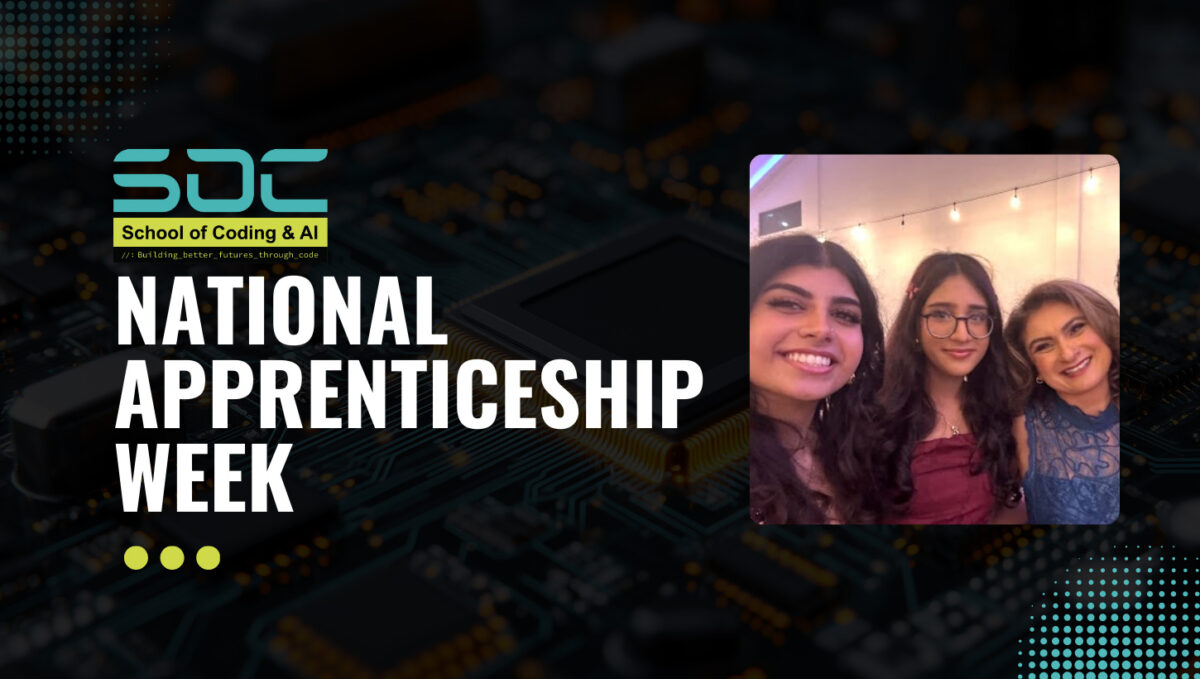
This year, we are honoured to celebrate the incredible journeys of Gurjot Kaur and Natasha Parbhakar, whose commitment and development perfectly capture the essence of apprenticeships. Their accomplishments were acknowledged at the 2025 Black Country Apprenticeship Awards, where Gurjot was nominated for Degree Apprentice of the Year, and Natasha was named Technology and Digital Apprentice of the Year. These honours are a reflection of both individual excellence and the culture of opportunity, trust and ongoing learning that SOC works to foster.

Our apprentices contribute to IT operations, compliance, SEND provision, work experience programs, international initiatives and curriculum development and student engagement, among other areas of the organisation. They bring new perspectives, technical expertise and a strong sense of responsibility to everything they do, which includes work in computing, cybersecurity, digital development and educational innovation. They gain the self-assurance and skills necessary to succeed in professional settings through practical projects and meaningful engagement.

At the School of Coding & AI, Natasha’s journey exemplifies the benefits of apprenticeship led growth. She says:

“My apprenticeship at School of Coding & AI has been a genuinely transformative experience. From early on, I was trusted with real responsibility, not just learning technical skills in software engineering but actively applying them across live projects, programme delivery, and digital development. Being involved in nationally funded initiatives, European projects, and internal platforms has allowed me to see how technology, education, and social impact come together in practice.”

She highlights how hands-on exposure has bridged the gap between theory and practice, allowing learning to translate into real-world outcomes. Beyond technical skills, Natasha’s experience also reflects the wider professional development apprentices gain at SOC. According to her:

“I have strengthened my communication, leadership and problem solving skills by working closely with colleagues across different teams… The experience has shown me that an apprenticeship is not just a route into a career, but a platform for growth, ownership and long-term progression.”

This sense of ownership, inclusion and purpose is central to how we nurture talent. Our apprentices are valued members of the team, empowered to contribute at both strategic and operational levels, while being supported by mentors who guide, challenge, and inspire them.

Gurjot’s words also showcase the support and trust at the School of Coding & AI that has helped her soar throughout the journey.     

“My apprenticeship at School of Coding & AI has been a defining part of my professional and personal development. As a Software Engineering Degree Apprentice, I’ve been allowed to work on real, high impact projects that go far beyond traditional learning. From contributing to digital product development and AI driven learning platforms to supporting funded programmes and strategic bids, my role has allowed me to apply academic learning directly to meaningful, real world outcomes. Being trusted with responsibility from an early stage has significantly accelerated my confidence, technical capability and understanding of how technology can be used to create social impact.”

She applauds the balance between the learning and hands-on delivery that has helped her gain confidence. She says: 

“What has truly set my apprenticeship apart is the supportive and ambitious culture at School of Coding. I’ve been encouraged to take ownership of projects, collaborate across teams and continuously push myself to grow both technically and professionally. The balance between structured learning and hands-on delivery has helped me develop strong problem-solving skills, adaptability and a clear sense of career direction. National Apprenticeship Week is a great opportunity to reflect on how apprenticeships like mine provide not just a qualification, but a genuine pathway to leadership, innovation and long-term growth within the tech sector.”

A mentor’s role is what moulds the apprentices into the successful professionals they become. Suki, Director of Academics at School of Coding & AI, has been the guiding torch through Gurjot and Natasha’s journey so far, and this is what she had to say about her experience with them: 

Over the course of their apprenticeship, Gurjot has shown impressive growth both professionally and personally. From the outset, Gurjot demonstrated a strong willingness to learn, take feedback on board and apply it with confidence. They have developed key workplace skills such as time management, communication and problem-solving, while also growing in self belief and independence. It has been rewarding to see Gurjot progress from needing guidance to taking initiative and contributing thoughtfully to the team.

Similarly, Natasha has made remarkable strides throughout her apprenticeship journey. She has consistently shown commitment, resilience and a positive attitude towards learning, even when faced with new challenges. Natasha has grown significantly in her technical abilities and professionalism, becoming more confident in her role and interactions with colleagues. Mentoring Natasha has been a pleasure and her development is a strong example of how apprenticeships can nurture talent, unlock potential and create clear pathways for future success.”

As we celebrate National Apprenticeship Week, we are reminded that apprenticeships are not just about skills; they are about confidence, character and creating pathways for long-term success. Natasha and Gurjot represent the very best of what apprenticeships can achieve and we are incredibly proud to have them at School of Coding & AI.

The future is bright, and our apprentices are leading the way.